The Daily Cosmos
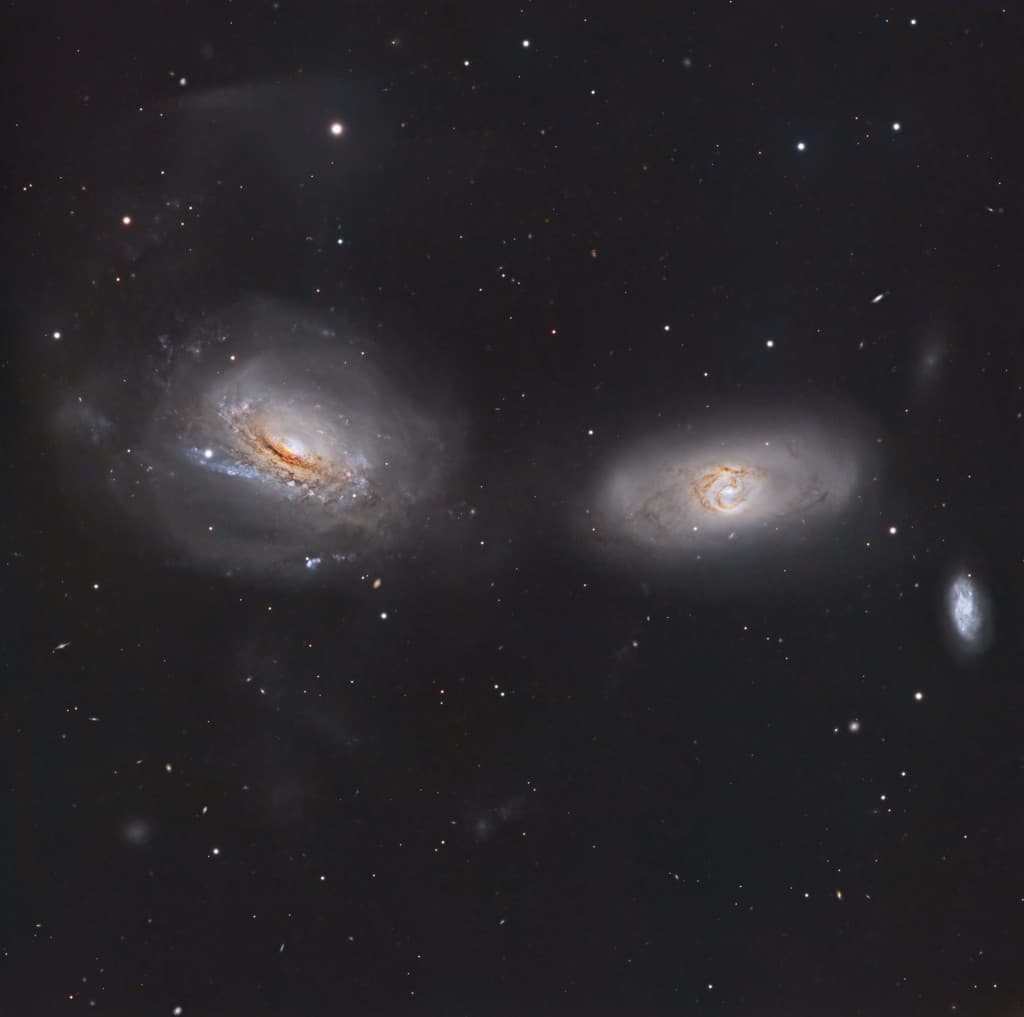
Unraveling NGC 3169
Spiral galaxy NGC 3169 looks to be unraveling like a ball of cosmic yarn. It lies some 70 million light-years away, south of bright star Regulus toward the faint constellation Sextans. Wound up spiral arms are pulled out into sweeping tidal tails as NGC 3169 (left) and neighboring NGC 3166 interact gravitationally. Eventually the galaxies will merge into one, a common fate even for bright galaxies in the local universe. Drawn out stellar arcs and plumes are clear indications of the ongoing gravitational interactions across the deep and colorful galaxy group photo. The telescopic frame spans about 20 arc minutes or about 400,000 light-years at the group's estimated distance, and includes smaller, bluish NGC 3165 to the right. NGC 3169 is also known to shine across the spectrum from radio to X-rays, harboring an active galactic nucleus that is the site of a supermassive black hole.
Welcome to The Daily Cosmos
The Daily Cosmos is your window to the wonders of the universe. Each day, we feature a stunning image from NASA's Astronomy Picture of the Day (APOD), accompanied by an insightful explanation from scientists, offering you a glimpse into the vast beauty of space.
Whether you're a space enthusiast or just curious about the cosmos, The Daily Cosmos makes it easy for you to discover the mysteries of our universe. From galaxies far away to the tiniest details of our own solar system, we bring you fresh perspectives every day, with the goal of sparking curiosity and inspiring awe.
So sit back, relax, and explore the infinite beauty of space—one image at a time.